Tuesday, June 17, 2014

The Forbidden City: Postmortem (part II)

I realized that training fresh-faced new GMs would be critical to bringing tabletop role-playing to my public school classroom.  At the first stage, as I ran whole-class sessions, I identified those students who quickly grasped the nature of the activity, who seemed to have some enthusiasm for it, and who had social credibility among their peers (other kids would tend to listen to them).  Having picked these students out, I realized that I would need to give them the proper supports before tossing them out of the boat if I was to have any hope of this experiment being successful ...
photo accessed here


2. Equip Them with Tools that are Accessible and Evocative 

At its heart, the quintessential activity of our sessions of Dagger for Kids is exploring locations, battling monsters, and looting treasure.  That meant the most basic (and frequent) questions posed to the GM, and the ones he or she needed to be able to answer most readily, were likely to be of this vein:

"We open the door.  What do we see?"

"What do you need to roll to hit a crocodile?"

"I rolled a 2 on my listen check.  What do I hear?"

"I did 5 damage!  Does that kill the ape?"

While these basics concepts would make the most frequent appearance in GM-to-player dialogue, I knew of course that there would be an entirely different layer of GM skill at work -- one that no simple flow chart or at-a-glance reference tool could begin to capture.  Examples of these more subtle activities include:

  • Use evocative language to describes the game environment and help players visualize and interpret it
  • Interpret and "translate" the results of die rolls into engaging narrative ("Your sword stroke shears through the serpent's neck in a spray of green ichor!")
  • Make spot rulings for situations not covered by the rules (jumping, climbing, picking locks, etc)
  • Evaluate and adjust challenges and rewards
  • Maintain a sense of suspense for players


Taken together, these two layers require tools that are both accessible (easy to grasp at a glance) and evocative (vivid, memorable, able to spark imagination and invite elaboration through the suggestion of action, narrative, and broader context).

As mentioned in an earlier post, to equip my GMs I set them up with the following:

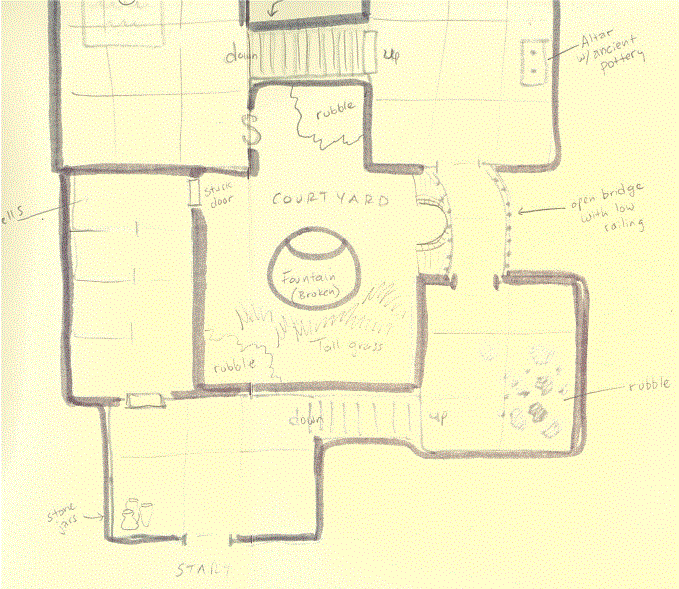
  1. a dungeon map sketched inside a manila folder
  2. a stack of monster illustration cards
  3. a 3x5 reference card listing several monster stats and treasures
  4. blank paper for maps, sketches, and notes
  5. copies of Dagger for Kids
  6. extra character sheets
  7. dice
I want to take a moment and focus on two of those tools in particular: dungeon maps and reference cards.

Displaying IMG_20140616_201317.jpg


The Dungeon Maps
  • drawn on the inside of a manila folder so that the GM could easily reference it while concealing it from the players -- this was just a practical approach and I was part way through my first map before I realized that I was aping the cover folder of TSR products from the 80s.
  • one GM mentioned that his players could see some of the contours (drawn in sharpie) through the folder -- until that moment I had never really questioned why The Keep on the Borderlands was rendered in that iconic light blue ... now I know!
  • I didn't bother with precise scale or grid lines (heresy!) but just divided the maps into general spaces, and even that seemed to prove unnecessary.
  • I wrote no separate room descriptions or room key, but annotated the maps directly in the style best seen in some of the better One Page Dungeon contest entries.
The bike I learned to ride on.
The 3x5 Reference Cards
  • monster stats had to be super short (one line)
  • info had to be large enough for the GM to read at a glance but too small for players to see easily
  • included more types of creatures than the GM would need in order to get fledgling GMs used to making choices and improvising
  • stats appeared in the sequence in which they were most likely to be needed: 
  1. Move ("Can they outrun us or not?")
  2. Armor Class ("Did I hit it?")
  3. Hit Points ("Did I kill it?")
  4. Damage ("Did I die when it bit me?")
  5. Special abilities (if any) that might come into play
  6. Experience Points awarded for defeating it
    .
  • I added a few treasures to the same card

After completing these, I remembered the old Monster & Treasure AssortmentI first saw a copy in 1986 and, already having a few years of role-playing under my belt at that point, I remember thinking, "Well that's stupid and pointless."  Why on earth would somebody pay hard-earned lawn-mowing cash to buy a list of monsters and treasures that you could just generate yourself?  
from wikipedia.org

Now, however, I think I understand what that product was actually aiming for -- I think it was just a set of training wheels intended as a highly accessible tool for GMs who were just starting out ... something to use for that first or second adventure and then pass on to your little brother.

Reflecting personally, the longer I GM, the less I need accessible tools (I'll never need to look up an orc's armor class for the rest of my life) and the more readily I recognize potential evocative tools when I see them. 

  • How often have you built scenarios inspired by a single photo?  
  • Why did the majority of published products, even those for experienced GMs and players, continue to cleave to the same mold as the accessible tools designed to ease new players into the hobby?
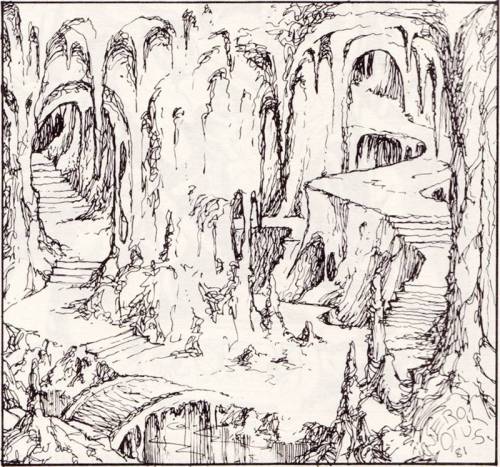
Can't you see the potential for adventure here ...photo accessed here
 ... or here?


by Erol Otus, accessed here

Monday, June 16, 2014

The Forbidden City: Postmortem (part I)

The school year is over, the monsoon rains have returned, and silence hangs over Bawal Bayan.  I'm not particularly good at letting things end and it's no coincidence that this year, like most, I was the very last teacher left on the hall after the posters came off the walls, the chairs were all stacked, and the lights were turned down.

"The panels shrunk, the windows cracked; fragments of plaster fell out of the ceiling, and the naked laths were shown instead; but how all this was brought about, Scrooge knew no more than you do. He only knew that it was quite correct; that everything had happened so; that there he was, alone again, when all the other boys had gone home for the jolly holidays." -- A Christmas Carol

.
This year, however, I have plenty of bones left to gnaw as I reflect on my experiment -- my effort to introduce tabletop role-playing, my own absurd hobby and passion, to my middle school students courtesy of Brave Halfling Publishing's Dagger for Kids.

It seems that the key to extending the reach of the adventure, interaction, and excitement of role-playing in the public school classroom lay in three steps:
  1. create a stable of novice GMs [Game Masters] within my classroom
  2. equip them with tools that are accessible and evocative 
  3. get out of the way
Each of these steps came with a measure of risk -- things could go all pear-shaped at any of several stages.
I'll be looking at each step in order as I reflect on what I learned over the last month or so.

1. Create a Stable of Novice GMs

Though Dagger for Kids was as simple as any rules set I've ever handled (maybe tying with S. John Ross's excellent Risus: The Anything RPG), I realized that functioning as an effective GM entails quite a few skills beyond managing dice mechanics -- everything from reading the table and adjusting pacing to stave off boredom to creating clear and evocative descriptions of locations and NPCS.  With play time limited (none of the 3-5 hour sessions we enjoyed as kids possible here) I opted to stack the deck in my favor and selected five students who I was confident had a pretty well developed set of communication skills for my first batch of newbie GMs.

If we were to employ the classic distinction between guilt cultures and shame cultures offered by E.R. Dodds  (The Greeks and the Irrational), then middle school is certainly a shame culture (perceived social status is paramount).  For this to work, I felt like I had to tap kids who were going to be able to command the respect and cooperation of their fellow students.
.
Merely knowing who could hold the attention of a table of his or her peers wasn't enough of course.  Enthusiasm for a fictional action-adventure setting and an interest in, or at least receptivity to the type of activity (cooperative gaming, collaborative storytelling, engaging in conflict with imaginary obstacles) was necessary as well.  This is where is it was so important that I run those first few whole-class sessions, watching to see who was highly engaged.  As mentioned in an earlier post, with such a large group the window of opportunity before distraction sets in is pretty small ... maybe one and a half class periods, so in the future I'll need to be much more focused on the players than on the game.  Short surveys can also help me identify novice GMs in the offing.

Sunday, June 15, 2014

The Forbidden City: Final Exam

With my entire classroom of middle school students finally engaged in tabletop role-playing, it didn't occur to me to wonder what would happen if I was removed from the equation, but of course that's precisely what happened ...  

I miss perhaps a single day of school each year, and that to attend a conference or a family function planned long in advance, but this year, in the final angst-ridden week of school, circumstances called me away for the mid-part of one day.  I was going to miss the first half of class!
Faced with the prospect of being absent from part of my Core block, quite a few questions came to mind:

What would happen when I was gone?  
How would the other adult called in to monitor things interpret or try to guide the action?
Should I just cancel our last session of the game and toss them a generic reading activity?  
Would the students take advantage of the small group structure to blow off the activity altogether?  
Would all of my dice disappear?
Hamburglar
from http://mugen.wikia.com/wiki/Hamburglar

To (hopefully) mitigate the chaos, I assigned kids to groups ahead of time, mainly keeping them with their existing parties of explorers, but making a tweak here or there to shift a couple of the stronger personalities around.  I briefed my Neophyte GMs the morning of my absence, showing each of them a separate cubby that contained a new folder-map, dice, rules, character sheets (including some blanks), and a second index card that introduced some new monsters and treasures which fit their dungeon thematically.  Finally, I banged out a quick background script to (hopefully) establish some theme and set things in motion.  

Before the instructional day started I asked a student who has a lot of enthusiasm and leadership qualities (Gilmie's player), to agree to read the script to the class after attendance was taken and before the GMs pulled their groups together.

Here's what he read to the class:

The monsoon rains are coming to Bawal Bayan!

The Bad News:

Soon the rainy season will begin and anyone still in the jungles around The Forbidden City will be trapped for six months without hope of rescue or resupply.  There’s only time for one more quick dash into the crater to recover treasure before the stockade is abandoned until next year!

The Good News:

A sturdy team of dwarven explorers has cut their way through the jungle to the southern rim of the crater.  Though a few were stung to death and carried off by giant hornets, the rest have managed to cut a dozen trees and roll them down into the ruined city below.  Those logs have been used to make a crude log-bridge across The Crevasse.  Now one last group of explorers has made their way through The Serpent Gate and to The Palace.  Below The Palace three separate routes into the tunnels below Bawal Bayan have been found.

One expedition will explore The Sewers of Bawal Bayan; another will dare The Catacombs; a final group will face The Dungeons of Bawal Bayan.

from tropicalandmonsoon.blogspot.com
And then I left for a couple hours.

Arriving back at my building I spared no haste making for my room.  From down the hallway I could hear voices and laughter and ... yes ... those were definitely the rattle of dice.  Without even pausing to check for traps I headed in ... and everything was cool. 

A bemused teacher looked on, probably wondering what exactly it was she was supposed to be doing, while the kids rolled dice, wove descriptions, and sketched dark corridors.  Trying to slap on my best Jane Goodall-nonchalant-face, I grabbed a notepad and jotted down some of what I overheard as I circulated around the room.  It's a collage of sorts, but a collage that any veteran of The Dungeon will recognize:

"Let's try to close the secret door and see if the statue turns back around."

"My ear got cut off!"

"You hear some screeching, what do you do?"

"It's probably a bat."

"I'm done!  I'm done!  I attack! 20 and 4!  What now, hunh?  What now?!"

"His armor class is so good because he's low to the ground."

"You're gonna drown."

"He can't swim?"

"He's got platemail on!"

"You might have found something better if you searched harder, but you didn't hold your breath long enough."

"Do you want to pull one of the levers?"

"Which one should I pull?"

When the class period began to wind down I prompted GMs to wrap up their last encounter and help players calculate how much wealth they had escaped with.  From there I had my kids complete a short reflective writing assignment.  Here are some excerpts from their writing:

"What happened in the game today?"

"In Dagger today we went into a sewer.  There were three passages and we all chose different ones ... "

"When I got to a large room there was a [giant] turtle and a puke monster ... [student] snuck away from us and found a room belonging to the snake people."

"First we entered a spinning, rotating, circular room.  We scrambled out into a dark, creepy tunnel.  The tunnel led to a room and inside were talking [stone] faces.  They were speaking different languages ..."
from geocaching.com

"What did your GM do well?"

"The GM did a good job making the monsters enter at a good part."

"All of the explaining needed."

"He moved the game along so that it flowed."

"He spoke on where we were and what was going on."

"He was creative and made good drawings."

"He did a good job of balancing out where the monsters were.  It was a good thing because I probably would have died in the beginning if he had put too many."

"What would make the game better?"

"More monsters."

"If more people were in the game."

"It would be better if attacking was more balanced and there were more characters [types]."

"If there was a dragon."

So in the end, we passed a test that I didn't even know was coming.

Thursday, June 12, 2014

The Forbidden City: session X

Escape from the Forbidden City!

Readers will recall from session nine that Victoria the Dwarf was the sole survivor of the most recent party of bold explorers to dare the dangers of Bawal Bayan.  The last of her companions, the long-lived and much beloved dwarf "Gilmie", was blasted into slag by a lightning bolt at the very end of the prior session.  The offending rogue wizard, master of the tasloi who haunt the city, was badly wounded and with his guard-panthers slain, he fled deeper into the ruins.
Like most bad guys, he's not so tough without his kitties (or his spells).
Victoria had a difficult choice before her: try to escape the crater or pursue the wizard into unexplored territory in hopes of avenging her fallen friends.  Though the young lady playing Victoria was not a gamer, I could tell that she was into the action and that the game was on her mind.  By mid-morning I'd overheard her talking to peers about the upcoming class:

"I want to go to Core [class] today!  I have a bunch to do ... but I'm pretty sure I'm going to die!"

Luck was with Victoria from the start as we settled in to resolve things.  She chose without any hesitation to pursue the fleeing wizard and his last pair of tasloi lackeys.  A die roll of 2 allowed her to pick up the blood trail and follow it to the shell of a ruined house.  A heavy tree limb had been dragged across the open doorway in a last ditch attempt to slow pursuit, but she didn't approach, opting instead to circle the structure.  The lone window was too high for her to reach easily.

"Can I roll a rock over to stand on so I can reach it?"

"Um, sure.  Sure you can."

Several tense rounds followed as she stepped atop the stone to fire her bow through the window while the pair of tasloi gave answer with hurled javelins and stones.  A quick flurry of fire and she'd break off to circle a bit, sometimes drawing near for a partially obstructed shot through the door, sometimes casting a stone of her own to cause a distraction.  At one point she spied a narrow crack at the rear of the crumbling house.


"I'm going to peek through it."

"Alright.  One of them must have heard you and was waiting just beyond the wall!  It thrusts at your face with its javelin [rolling a 15] and just barely misses.  The stone point scrapes across your armored collar!"
Cat and Mouse


And so it went.  Eventually, running low on arrows, she heaved the tree limb out of the doorway:

"I want ... I want to turn it like this so that ... yeah, so that I don't have my back to them."

Her next arrow slew one of the tasloi "gremlins" and the other failed its morale check and dove through the window (though she tried to catch it!).  But where was the wizard?  The spider hole in the corner couldn't hide long from dwarven eyes and soon Victoria had uncovered the dusty canvas concealing a crawlspace.

"I guess I do down it -- no, wait!  I search first, then drop down."

The wizard, out of spells and henchmen, had no way of knowing that his pursuer would be so relentless ... or that she'd be a dwarf!  The darkness and low ceiling of the crawlspace only aided her pursuit and soon she overtook the fleeing wizard, struggling along in his robe on hands and knees while trying to drag a sack behind him.

"I know what you have come for!  The secrets of life eternal!  The Yuan-Ti know ... the Yuan-Ti have much to teach!"

Victoria, however, was completely unimpressed by the villain's attempt to monologue.

"I shoot him."

When the first arrow missed, he just started talking faster, fumbling for his dagger in the darkness.

"Wait!  Wait!  I have gold ... I'll give you gold if you let me live!"

She wasn't having it.

"Nope.  I'm not listening.  I just shoot again."

And then the wizard was no more.  Victoria wasted no time, but began to pick through the treasures in the sack.  Dagger for Kids has no encumbrance rules, but I just limit my players to six items (the number of blanks in the equipment section of their character sheets).  It works amazingly well and couldn't be simpler.  Victoria finally chose the wizard's golden serpent staff and the jeweled fillet from his brow, keeping her bow but abandoning her shield to make room for another piece of loot.

Now began the long, lonely, dangerous trek across the crater of Bawal Bayan and back to the safety of The Stockade.  Victoria wasn't going to be entered any marked section of The Forbidden City, so the main danger would be from wandering monsters.  

I decided to handle it like this:
I'd roll a 1D20 check every time she entered the territory of a particular creature type.
  • 20 = immediate ambush
  • 19-17 = and encounter
  • 16-14 = signs of a creature nearby
  • 13-1 = all clear
I rolled a check while she hurried across the open ground south of The Palace, reasoning that a couple of the surviving tasloi may still be nearby.

(Nothing.)

When she came to The Crevasse I allowed her to roll a die to see if all three ropes had been cut -- one remained and she shimmed across.
I rolled another check.
(All clear.)

North of The Labyrinth she skirted along the edge of the territory hunted by both the Giant Caddisfly Larvae and the robberflies.

Two checks.
(Nothing and nothing.)

The player was practically squirming in her seat at this point, staring hard at the map as I made her trace and retrace her exact line of travel.

When she passed under the lee of The Fallen Colossus I made a check to see if the mongrelmen were still riled.

A 14 meant that she heard some gabbling cries echo off the cliff walls, but saw nothing.

She made a dash for The Black Canyon and I rolled a check at the repaired rope bridge (a bluff, I knew that area had been cleared) and a check in the grotto of the Yellow Musk Creepers.  At this stage I veered from my usual habit of rolling everything in the open and, as Victoria saw the grim line of the corpses of her former companions, now swathed in heavy vines and sprouting pale buds from eye sockets and mouths, she had no way of knowing if the zombies were about to become active or if they were still dormant.  She hesitated for a moment.

"How many of them are there?"

"You can see about 12.  There might be others tangled within the masses of vines."

"Ugh."
explorers as fertilizer
After firing her last arrow into the knee of one zombie (it didn't respond) she climbed down to the sandy floor and picked her way gingerly along the wall, staying as far from the dead as possible.

I rolled a check as she paddled across the Crocodile Pool and slipped out into the jungle where night had fallen.
(Nothing.)

Treading carefully, she followed the jungle trail as the tasloi began to whistle and shriek in the distance.  One final wandering monster check (all clear) and Victoria was home free and slipped within the protective walls of the Explorers' Palisade.  I got a cheer and a spontaneous fist pump as Victoria counted her loot and became the first of our middle school students to level up!

Wednesday, June 11, 2014

The Quest for the Amazing Replicating GM (part IV)

How We Rolled

I took the leap.  I risked classroom disaster and turned the role of GM over to five of my students as we played Brave Halfling Publishing's rules lite Dagger for Kids.  I equipped them with annotated maps, super-simple stat blocks, and a few dice and then I took the hardest step of all ... I turned my back and settled in to work with a few kids off to the side.
free version available on RPGnow.com
I was there in the room, but without managing individual tables how could I know if the kids were giving the neophyte GMs enough respect to run a game?  Were people struggling with rules, getting bogged down in details, or becoming comfortable improvising?  Were they managing the pace to stave off boredom?  Were they evoking a sense of place with descriptions, however simple or fumbling?

I let them know that they could bring me questions if they got stuck, and then I waited ... and waited ... 30 minutes went by and nobody came over to ask even the first question.  I excused myself from the students I was helping and did a quick walk of the room, catching snatches of conversation as I went, 

"... okay, you hit the gremlin, but you don't kill it ... "

" ... I roll a search check, what do I find? ..."

" ... there's another one of the zombie-things there and it tries to grab you ... "

Everybody was role-playing ... an entire room full of middle school kids was checking for secret doors, navigating pits, and slaying monsters down in the dungeon!

As class wrapped up I gave them a 10 minute warning and encouraged them to make this their last encounter (or "scene").  They kept right on playing.  Watching the clock, I repeated the instruction, but by then I could see that I'd need to pull the plug in order to get materials put away and the room rearranged before classes changed.

With scant minutes to spare I had the students do some writing to recount what had happened in their games.  Here are some excerpts from what they wrote:

-- Group A

"I went a different way than the others, then I fought off some gremlins.  I ran into some snake skin and was very cautious, then I went searching and found some treasure ... the others died.  The best part for me was searching and finding treasure.  I also learned how to survive by myself."

"I went north into a room with stains and moaning.  I fought and defeated some plant zombies with [Student] and gained some xp.  We then came across the dead body of a dwarf but continued onward ... I learned that in order to survive you have to be cautious and wary of your surroundings."

"In the middle of the game [student] ending up dying by a bullywug ... I learned that knights have a better chance of surviving over wizards."

-- Group B

"We didn't find much except for a few zombies, a spear, and a dagger.  However, I opened a door and found a gorilla, so I slammed it shut and ran for my life.  So while [student], [other student], gremlins and a gorilla fought each other, I got locked out, snuck around, and stole all the loot!"

-- Group C

"I died twice and I learned how to play a new game and we found monsters in the rooms and we searched them and I tried to kill them but I died but then blocked some hits and then kept finding nothing.  The game was fun to play and we laughed a lot."

-- Group D

"In the game we had to fight zombies, cross a bridge, and fight gremlins.  I almost died when we had to fight a gorilla.  I learned that to survive you should make allies ... the best part in Dagger was when we destroyed the gorilla."

-- Group E

"We entered three rooms and discovered two apes.  We fought them and lost a man.  We moved on to a room with a pool in it.  Frogs shot another person, but I lived through so far ... if you live [through battle] it makes you feel like you accomplished something."

So with about a class period and a half to spare, I think I've struck gold here.  In future posts I'll give another report on actual play and do some reflection on some of the bigger questions about what this experiment means within the context of my classroom.

Tuesday, June 10, 2014

The Quest for the Amazing Replicating GM (part III)

Is it possible to get an entire class full of middle school students introduced to tabletop role-playing at the same time?

I realized that the trick would be to produce cadet GMs [Game Masters] who could maintain the excitement and action while still allowing for players to be arranged in small groups.

This time my approach would focus on giving my would-be referees the tools to lead the activity of role-playing.  I scrambled madly the night before and part of that morning to get materials together. Then, at the start of class I pulled five of my most precocious map-makers together into a huddle.

"Okay, you guys are going to lead groups of three or four kids through a dungeon today, just like you've seen me referee ..."

Each fledgling GM was given the following:

1. A GM map of a five-room dungeon, sketched on the inside of a manila folder.

I divided rooms and halls into areas in case they wanted to use the movement rules from Dagger for Kids. More importantly, I made notes in pencil next to many rooms ("pool of murky water" or "mass of roots grow through a crack in the wall"). This completely eliminated the need for paragraphs of text to be read beforehand and rescued my neophytes from becoming slaves to boxed text.

sample folder map


2. A stack of half-index cards (3"x2.5").

Each had a picture of a monster on it. I advised them to select 3-6 cards and pick locations for those creatures. I suggested that when a monster was encountered, they could describe the creature, lay out the card, or both; whatever they preferred. None of the monster cards were marked with names, stats, or any other info; just a picture of the creature.


3. An index card listing stats for each type of monster and several treasures

Example: Carnivorous Ape: move 4, AC 13, Hit points 14, bite 1d6, 50 xp.

Example: Jade necklace: uses 1 equipment space, 1d20 x 20 xp. 

I advised the GMs to pick locations for two of the treasures and I reminded them that treasure only grants experience points to the character who successfully carries it out of the dungeon.

4. A sheet of white paper for sketching maps or making notes.

5. Two copies of Dagger for Kids in case a rules question came up.

a fine introductory tool!

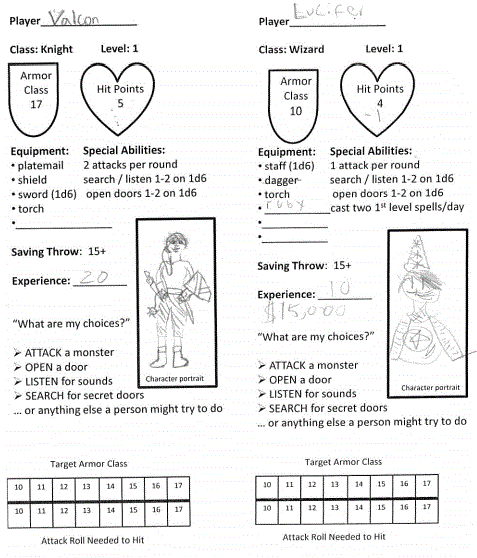
6. A half-dozen character sheets.

Here are a knight and a wizard!
7. Two 20-siders and two 6-siders.

I pulled my six Bawal Bayan explorers aside and then divided the remaining eighteen students among my five newbie GMs.

"Look over your maps. Decide where the monsters and treasure should go while your players choose what character class they want to play. Then get started as soon as you are ready. I'll be running a session at this table over here in case you need help ..."

Next Time: How We Rolled